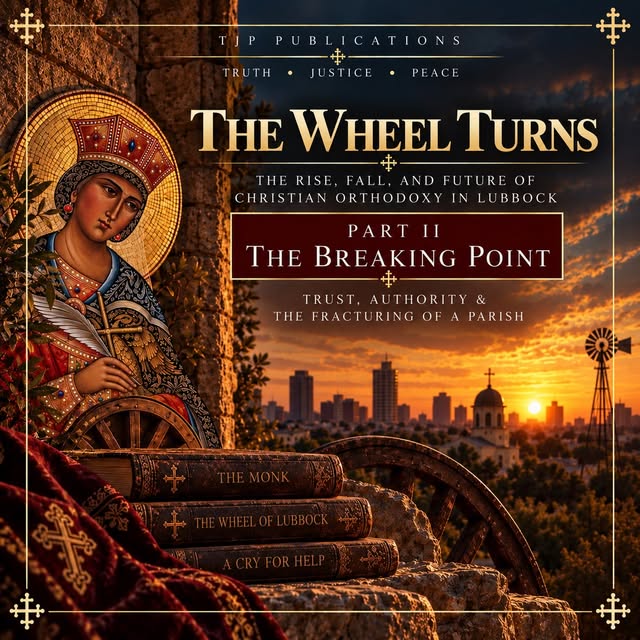
Part II — Breaking Point
Trust, Authority & the Fracturing of a Parish
The story continues.
Part I of The Wheel Turns established the beginning of Orthodox Christianity in Lubbock and followed the formation of Saint Catherine Orthodox Mission through the arrival of Father Alexander on October 6, 2020. Part II begins at that moment and follows the years that would transform the young mission, its leadership, and the people who had gathered around it.
Acts III.V through V take the story beyond the parish’s formation and into the circumstances that eventually brought members of the community to appeal to ecclesiastical authority. Before examining the conflict itself, however, we must first understand the man who arrived in Lubbock, the parish he entered, and the relationship that developed between the two.
THE MAN BEFORE LUBBOCK
Before Lubbock, there was Mallorca. Before Mallorca, there was Germany. And before Germany, there was Baia Mare, Romania, where Raul Alexandru Cordos was born during the final years of communist Romania. His early life unfolded during a period of extraordinary change in Eastern Europe, and his journey would eventually take him across several countries and into several different Orthodox communities before he arrived in West Texas.
At fifteen, Raul moved to Mallorca, where his religious life began to take shape. He studied theology in Mallorca and Barcelona, served as an altar server in a Russian Orthodox parish, and came under the influence of Orthodox clergy. In 2011 he was ordained a deacon by Metropolitan Polycarp of the Ecumenical Patriarchate, and the following year he was ordained a priest. In 2015, he was tonsured a monk and received the name Alexander. His journey would eventually continue across the Atlantic, through Michigan, and into ROCOR before bringing him to Saint Catherine in Lubbock.
The journey itself raises questions that remain important to the story. What brought him to Germany and Mallorca? What exactly was his role in the communities he served in the Balearic Islands? What brought him to Michigan, and what occurred there before his eventual reception into ROCOR? What circumstances led to his canonical release from the Ecumenical Patriarchate? These questions are not presented as conclusions, but as gaps in the historical record that deserve to be examined by those who were there.
By the time Father Alexander arrived in Lubbock, he had already traveled through a remarkable portion of the Orthodox world. His story stretched from Romania to Germany, from Germany to Spain, from the Ecumenical Patriarchate to Michigan, and finally into ROCOR and West Texas. Part II begins by following that journey because the history of Saint Catherine did not begin when he arrived; he arrived carrying a history of his own.
THE WHEEL BEGINS
By October 2020, Saint Catherine’s had already begun to become something more than an idea. A community had gathered, people had invested themselves in the mission, and the young Orthodox community in Lubbock had begun the slow process of becoming a parish. Father Alexander entered a community that was ready to be led, and in a small mission the relationship between priest and people naturally becomes especially significant.
The priest celebrates the services, teaches the faithful, hears confessions, baptizes children, marries families, visits the sick, answers questions, and stands before the community as the visible representative of its sacramental life. In a small parish, there are few layers between the priest and the people, and the rector can become the person through whom much of the community’s life is organized. That can be a tremendous blessing, but it can also create a vulnerability when the distinction between the institution and the person leading it begins to blur.
Saint Catherine’s was the circumference of the wheel: the families, converts, children, servers, singers, volunteers, donors, and parishioners who gave the mission its life. Father Alexander increasingly became its center. The Church belonged to Christ, the mission belonged to the Church, and the priest served the mission, but the smaller the community became, the more difficult those distinctions could become in the lived experience of the people within it.
At this stage, there was nothing inherently alarming about that arrangement. People entering an Orthodox mission were looking for structure, tradition, discipline, authority, and a place where they could learn how to live the Christian life. Trust developed through ordinary interactions, expectations were established through repetition, and a parish culture began forming long before anyone thought to define it. The people were learning their priest, the priest was learning his people, and Saint Catherine’s was becoming a community.
That is where the wheel begins.
WHEN TRUST BECOMES PRESSURE
The wheel turns gradually. A small instruction becomes an expectation, an expectation becomes a norm, and eventually a norm becomes part of the identity of a community. Trust develops in much the same way, one interaction at a time, until people begin to understand the parish through relationships and patterns that have accumulated over months and years. By the time disagreement eventually emerges, it does not enter an empty room. It collides with everything that has already been built.
The distinction between authority and control therefore becomes important. A priest possesses legitimate authority within the Church and may provide pastoral direction, correction, instruction, and discipline within the boundaries of his office. None of those things, by themselves, establish that anything improper has occurred. The question is what happens when those boundaries become less clear, and what happens when a parishioner does not agree with the person exercising that authority.
The people of Saint Catherine’s did not initially join the mission because they wanted to resist authority. They joined because they wanted a Church. They wanted stability, sacramental life, fellowship, and a community that could establish Orthodox Christianity in Lubbock and leave something behind for those who would come after them. They believed in the mission, believed in the Church, and in good faith trusted their priest.
As the years passed, however, the Church, the mission, and the priest would become increasingly difficult to distinguish from one another in the lived experience of the community. The relationship that had helped the mission grow would eventually become central to understanding the conflict that followed. The same trust that allowed a young parish to flourish could make disagreement far more consequential when that trust began to fracture.
THE BREAKING POINT
Every parish experiences conflict. Disagreements over priorities, personalities, administration, finances, worship, leadership, and countless other matters are part of the ordinary difficulty of building a permanent community. Conflict alone is therefore not evidence of institutional failure. The more important question is what that conflict produces and whether the community is capable of responding when people begin to hurt.
At some point in the history examined in Part II, the pressure appears to have crossed that threshold. People began putting their experiences into writing and bringing their concerns beyond the parish itself. Their appeals were addressed to Archbishop Gabriel, placing the conflict into the hands of ecclesiastical authority beyond the local community. The letters do not, by their existence alone, establish the truth of every allegation contained within them, but they do establish that individuals believed the situation had become serious enough to seek intervention.
The letters are therefore important historical records because they preserve what people were reporting, experiencing, believing, or witnessing while the conflict was still unfolding. They cannot answer every question, and they cannot substitute for an investigation into the underlying events, but they provide a record of the moment when members of the parish believed they could no longer resolve the situation within the parish itself. The people were, in a very real sense, crying out from the wheel and asking the Church to look at what was happening.
Then the circumstances changed. Archbishop Gabriel was the recipient of those appeals, while Bishop Spyridon inherited the aftermath. That transition creates another major question in the historical record: what happened after the Church was placed on notice? Whether there was an investigation, what it established, whether people were interviewed, whether corrective measures were taken, and how the leadership responded are questions that require documentation rather than speculation.
That is where Part II ends.
Not with a final verdict, but with a question.
What happened when someone finally had the authority to reach back?
READ PART II IN FULL
THE WHEEL TURNS — PART II: BREAKING POINT
Acts III.V–V
Part II of The Wheel Turns is now available in full. The complete installment follows the journey from the man who arrived in Lubbock to the formation of the parish around its new rector, through the pressures that eventually became wounds and the appeals that carried those wounds beyond the parish itself.
Download document: The Wheel Turns Part II
AN OPEN RECORD
The Wheel Turns is intended to preserve a documentary record of a community and a period of significant change. TJP Publications welcomes correspondence from journalists, historians, researchers, clergy, former participants, witnesses, and others who possess relevant documentation or firsthand knowledge concerning the events discussed in the project. Additional documentation, corrections, and substantive responses are welcome.
The investigation distinguishes between what can be documented, what is reported through firsthand testimony, what remains disputed, and what remains unanswered. Where the available evidence does not establish an answer, the project does not attempt to manufacture one.
Part I established the beginning.
Part II follows the wheel to the breaking point.
THE WHEEL TURNS.