The End of an Old World
History rarely ends where we expect it to. Empires fall, nations are transformed, and institutions that once appeared immovable find themselves struggling to survive. Yet the end of one world does not necessarily mean the end of the people who inhabited it. Sometimes, what disappears from the map continues to live through memory, tradition, faith, and the generations that carry it forward.
Russia stands among the most consequential examples of this historical continuity. Its imperial past, Orthodox Christian heritage, revolutionary upheaval, and subsequent diaspora form a story that extends far beyond the borders of the modern Russian state. The events that shattered the old order did not simply rearrange political power; they forced a civilization to confront what could be preserved, what would be lost, and what might emerge from the ruins.
The Long Shadow of Russia begins at the intersection of these questions. It is an investigation into the historical forces that shaped Russia and the Russian Church Abroad, following the threads of persecution, exile, reconciliation, and division across generations. Its purpose is not merely to recount the events themselves, but to examine the people, institutions, and enduring questions left in their wake.
Part I, The End of an Old World, opens with two acts. The first turns toward an icon and the spiritual world it represents. The second moves into the revolutionary upheaval that would change Russia forever.
Act I — The Inexhaustible Cup
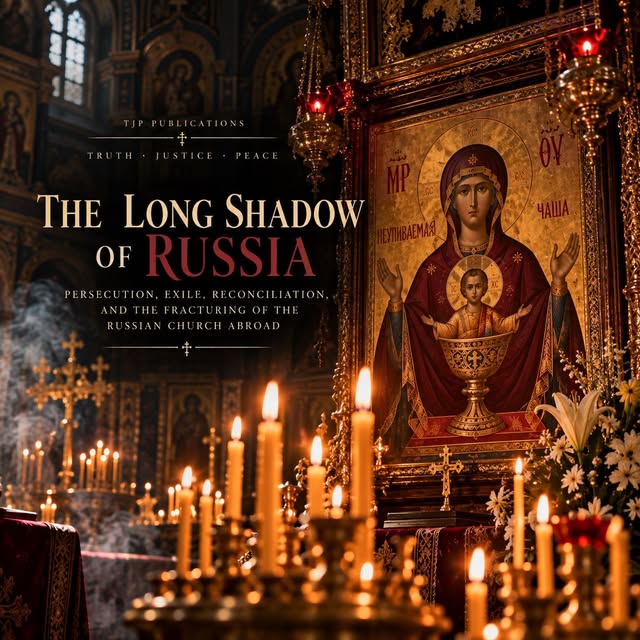
In 1878, a story of suffering, repentance, and healing became associated with the icon of the Mother of God known as the Inexhaustible Cup. According to the traditional account, a man whose life had been consumed by alcoholism was directed in a dream to travel to a monastery in Serpukhov. Despite his physical condition, he made the journey, where the icon and its connection to his recovery became known.
The story offers a striking point of departure for a history of Russia. Here, the narrative begins not with an emperor, a battlefield, or a political manifesto, but with an individual in need of restoration and a tradition that directed him toward hope. The icon’s enduring place in Orthodox devotion provides an opportunity to consider the spiritual world that existed before the upheavals of the twentieth century, as well as the religious memory carried beyond it.
The Inexhaustible Cup is the threshold through which this history begins. It introduces a world whose significance cannot be measured solely through its political institutions or imperial achievements. To understand what was lost, transformed, and carried into exile, we must first consider what gave that world meaning to the people who inhabited it.
Act II — The Revolution
The Russian Revolution was not an isolated moment detached from the history that preceded it. It emerged from a period of war, political instability, social strain, and mounting challenges to the existing order. The collapse of Imperial Russia brought an end to a centuries-old monarchy and opened a period of upheaval whose consequences extended far beyond the immediate struggle for political power.
For the Russian Orthodox Church, the transformation of the state would become a defining historical rupture. The relationship between Church and empire had been deeply intertwined, and the destruction of the old political order created new circumstances for religious life, ecclesiastical authority, and the survival of Orthodox communities. Persecution, displacement, and uncertainty would become central features of the world that followed.
Yet the revolution did not bring every part of Russian life to an end. People fled, communities were scattered, and institutions struggled to adapt to circumstances few could have anticipated. Russian history continued beyond the borders of Russia itself, carried by those who left and by those who remained.
The revolutionary period therefore marks more than the fall of an empire. It marks the beginning of a new historical question: what happens when a people lose the world that once gave their institutions, traditions, and collective memory their familiar place?
What’s To Come
The first two acts establish the historical ground from which the larger investigation proceeds. They introduce the spiritual inheritance of Imperial Russia and the upheaval that transformed its future, setting the stage for a history that cannot be contained within the rise and fall of a single state.
The Church Abroad would become one of the principal arenas in which these questions continued to unfold. Exile raised difficult questions of authority, identity, continuity, and belonging. The return of religious life to Russia would eventually introduce another set of questions, while reconciliation and renewed division would complicate any simple account of what it meant to preserve the Russian ecclesiastical inheritance.
These subjects belong to the chapters ahead. They cannot be resolved by treating exile as a footnote to Russian history or by assuming that the restoration of familiar institutions automatically settles the questions created by their separation. They require a careful examination of events, documents, decisions, and the people whose lives were shaped by them.
The Long Shadow of Russia is an ongoing historical investigation. This first installment opens the story; it does not claim to close it. The work ahead will continue to examine the evidence, pursue unanswered questions, and distinguish what the historical record establishes from what remains uncertain.
The old world came to an end. Its consequences did not.
Read Part I: The End of an Old World
The complete manuscript of The Long Shadow of Russia — Part I: The End of an Old World, containing Acts I and II, is included below.
This is where the investigation begins. The history of Russia, the experience of exile, and the future of the Russian Church Abroad remain inseparable from the questions this work seeks to explore.
Download document: The Long Shadow Of Russia Part I
☦️ Truth | ⚖️ Justice | 🕊️ Peace
TJP Publications