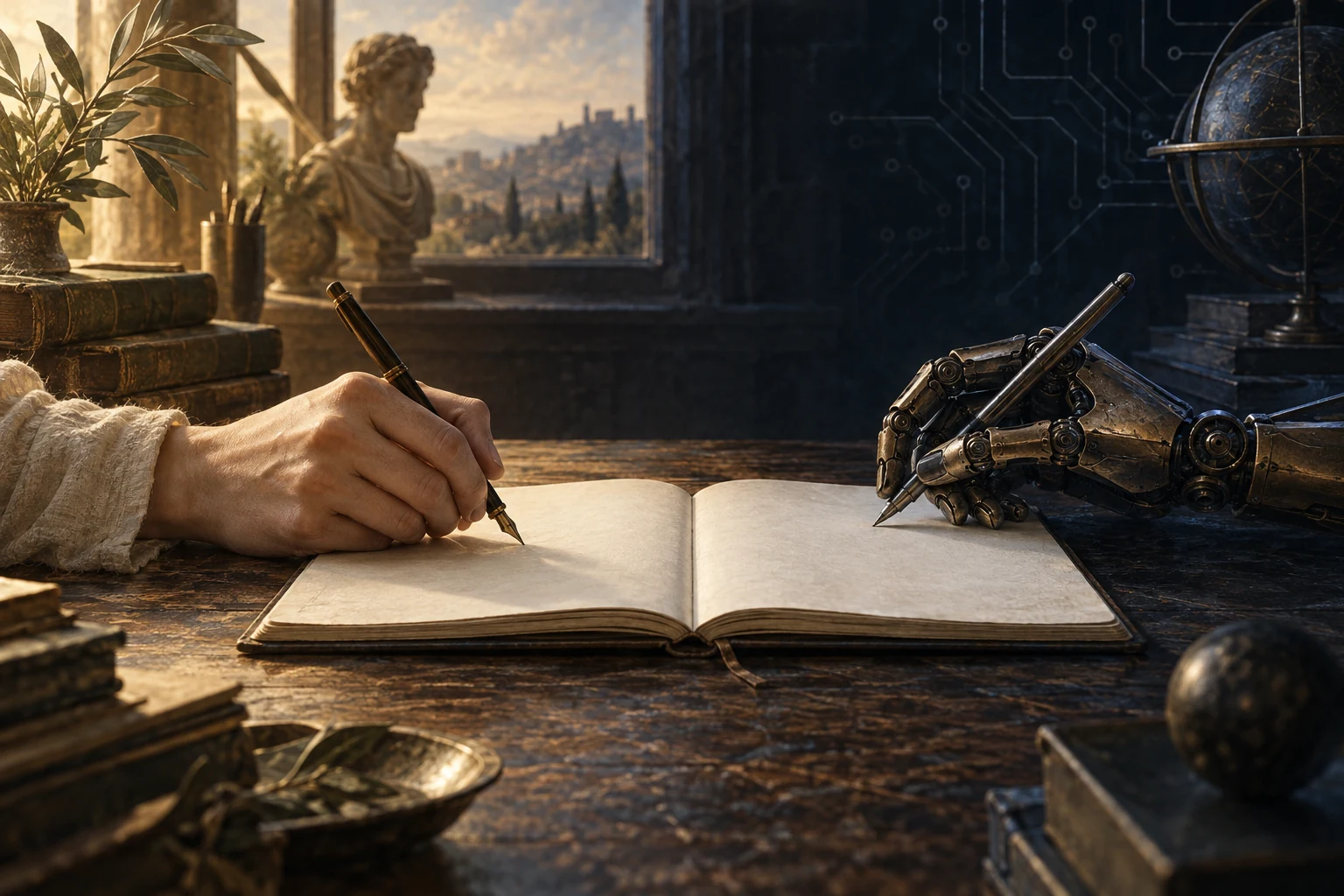
Imagine paying eight dollars a month for a servant who never sleeps, never asks for a raise, and is available whenever you need something done. It can help you research a subject, organize your schedule, learn a new skill, or work through a problem that would otherwise take hours. It doesn’t need an office, a lunch break, or a paycheck. You give it instructions, and it gets to work.
Of course, an artificial intelligence isn’t a human being, and using one isn’t the same as owning another person. But the comparison raises a question worth asking: have we finally built the servant humanity has always wanted? For centuries, people have searched for ways to escape the burdens of labor, whether through the exploitation of other human beings or the development of machines that could do the work instead. Now we’re entering a period when machines can perform not only physical labor but an expanding range of intellectual tasks. The old relationship between master and servant is taking on a new form, and it isn’t entirely clear who will benefit most from it.
The Perfect Servant
Human history is full of attempts to make work easier, cheaper, and less dependent on human effort. Ancient societies relied on slavery to sustain their economies, and the Industrial Revolution introduced machinery that transformed how goods were produced and how workers earned their living. These developments are not morally equivalent, and the suffering inflicted by human slavery cannot be reduced to a comparison with technology. But both history and economics reveal something uncomfortable about us: when we find a way to obtain more labor for less money, we have a tendency to pursue it.
Artificial intelligence takes that desire into unfamiliar territory. A machine can now assist with tasks that once required specialized knowledge, expensive services, or hours of concentrated effort. A student can use it to understand a difficult subject, a small business owner can use it to develop marketing materials, and an individual can explore unfamiliar subjects without having to pay for specialized assistance. Tasks that once required considerably more time, money, or expertise are becoming accessible to people who previously lacked those resources.
For someone with limited money, those capabilities can be life-changing. A person who cannot afford a tutor, editor, or research assistant suddenly has access to assistance that would have been out of reach a generation ago. The machine can make one person more capable without requiring that person to become wealthy first. That is a real benefit, and it deserves recognition.
But there is another side to the bargain. If a machine can perform a task for a fraction of what it costs to employ a person, employers have an obvious financial incentive to use it. A company doesn’t have to hate its employees to replace some of their work. It simply has to decide that the cheaper option makes better business sense. What begins as a tool for helping workers can become a means of reducing the number of workers a business needs.
The question is not whether every job will disappear or whether every technological advance will leave people worse off. History doesn’t support such simple predictions. The question is what happens when the ability to replace human labor becomes increasingly powerful, and whether the people affected by that change will share in the benefits or bear most of the costs.
Who Owns the Machine?
There is an irony in our new relationship with artificial intelligence. We may be the ones giving the commands, but we generally don’t own the systems carrying them out. The models, computing infrastructure, and platforms belong to the companies that develop and operate them. We pay for access, agree to their terms, and build our routines around the capabilities they provide.
Think about that for a moment. You can use a machine to help run your business, complete your education, or accomplish work that would otherwise require a team of people. Yet the company behind that machine can change its prices, restrict its features, or discontinue a service you have come to rely on. You control the instructions, but you don’t control the conditions under which the machine serves you.
This is where the metaphor begins to turn against us. The person using AI may feel like the master, but the actual ownership rests elsewhere. We can become more productive while becoming more dependent on the people who control the technology. And if these systems become essential to employment, education, and ordinary economic life, dependence on them may become difficult to avoid.
Consider the difference between using a tool because it is convenient and needing it because everything around you has been organized to require it. The first is a choice. The second can become a constraint. If a business builds its entire operation around one platform, an employee loses the skills needed to work without it, or a student becomes unable to approach a problem without asking a machine for the answer, the relationship has changed. The tool is no longer simply making life easier; it has become part of the structure that determines what a person can do.
The machine doesn’t have to demand obedience. Nobody has to force us to depend on it. We can arrive at that point through convenience, financial pressure, and the reasonable desire to make our lives easier. The danger is that we may not recognize the loss of independence because each individual step appears to be an improvement.
The Servant Becomes the Master
The economic consequences are only part of the problem. There is also a question about what happens to us when we become accustomed to having a machine do our thinking alongside our work.
Used properly, AI can help people learn. It can explain difficult concepts, challenge an argument, identify gaps in research, and help someone understand a subject they might otherwise struggle to approach. But there is a difference between using a tool to improve your understanding and using it to avoid understanding something at all. If we accept whatever it produces without examining the answer, we haven’t necessarily become more knowledgeable. We may simply have become better at obtaining answers.
The same applies to writing, planning, and decision-making. There is nothing inherently wrong with receiving assistance, but assistance is supposed to help us accomplish something, not eliminate the need for judgment altogether. When we stop practicing skills because a machine can perform them, we risk losing the ability to recognize when the machine is wrong. We can end up depending on the very system whose output we are supposed to evaluate.
This isn’t an argument that everyone who uses AI will become intellectually lazy. People have always relied on tools, books, teachers, and other people to expand their understanding. The important distinction is whether those resources help us develop our abilities or become substitutes for exercising them. A person who uses AI to investigate a question may come away knowing more than before. A person who uses it to avoid thinking about the question may come away with a polished answer and very little understanding.
There is a larger lesson here. We tend to think of slavery as a relationship in which one party exercises control over another. Yet dependence can also limit freedom without anyone explicitly demanding submission. An individual can become so reliant on a system that the ability to function independently begins to disappear. That isn’t equivalent to human enslavement, but it is a real question about autonomy, and it becomes more important as technology occupies more of our lives.
We set out to build machines that would serve us. We should be careful not to create a world in which we can no longer function without them.
We Cannot Serve Two Masters
For an Orthodox Christian, this question eventually leads somewhere beyond economics. In Matthew 6:24, Christ teaches, “No one can serve two masters” (NKJV), warning that we cannot serve both God and mammon. His words concern the competing claims of God and material wealth, not artificial intelligence. Still, the principle speaks to the way we order our lives and the things we allow to govern our decisions.
There is nothing inherently wrong with using technology to work more efficiently, earn a living, or make knowledge more accessible. The problem begins when efficiency becomes the highest priority and everything else is expected to accommodate it. If every decision is measured by how much time it saves or how much money it produces, we can gradually lose sight of the things those savings and profits were supposed to make possible in the first place.
An Orthodox understanding of the spiritual life places importance on self-discipline, watchfulness, and the struggle against disordered attachments. Applied to technology, that means asking ourselves whether we can use a tool without becoming dependent on it, whether we can put it aside when our responsibilities require it, and whether we still exercise our own judgment when an easy answer is available. The issue isn’t whether the machine is powerful. It’s whether we remain capable of governing our relationship with it.
We can also ask what happens when economic productivity becomes the measure of human worth. If AI allows a company to accomplish more with fewer employees, the resulting savings may benefit its owners and customers. But the workers whose livelihoods are affected are not disposable simply because a machine can perform some of their tasks more cheaply. Human dignity cannot depend entirely on whether someone can compete with the latest technology.
Christ’s warning about serving two masters reminds us that material success is not the ultimate measure of a life. We can acquire tools that make us more efficient, build systems that generate more wealth, and eliminate countless inconveniences without necessarily becoming wiser, more generous, or more free. If the pursuit of productivity leads us to neglect our responsibilities to God and to one another, then we have to reconsider what we think progress is supposed to accomplish.
The question is not whether AI itself is a rival to God. It is whether we will allow convenience, wealth, or the demand for constant productivity to take a place in our lives that they do not deserve.
The New Age of Servitude
Artificial intelligence offers genuine opportunities. It can help individuals accomplish work that once required substantial resources, make specialized knowledge more accessible, and give small organizations capabilities that previously belonged mostly to larger ones. Rejecting those benefits simply because the technology introduces new risks would be shortsighted. But embracing the technology without examining who controls it, who profits from it, and what dependence it creates would be just as shortsighted.
We should ask who owns the machines, who benefits when human labor becomes less necessary, and what options remain for people whose work is disrupted. We should ask whether our reliance on privately controlled systems leaves us with meaningful alternatives. And we should ask whether we are using these tools to develop our abilities or gradually surrendering those abilities because doing so is easier.
The paradox is that both sides of this relationship can be true. AI can make an individual more independent by providing assistance that was previously unaffordable, while making that same individual more dependent on the company providing it. It can free someone from tedious work while threatening the livelihood of another person who performs that work for a living. It can help us learn while tempting us to accept answers without learning anything at all.
The machine may be our servant, but we do not own everything that makes it work. We may command it, but we cannot assume that we control the economic system surrounding it. And we may use it to accomplish more than ever before, but accomplishing more is not the same as becoming more free.
Humanity has spent centuries searching for ways to escape the burdens of labor. Now we are building machines capable of taking over an expanding share of that labor, and we must decide what we intend to do with the freedom they promise. If the result is a world in which a small number of institutions control increasingly essential technology while everyone else becomes dependent on it, then we may have changed the machinery of servitude without resolving the underlying problem of power.
Perhaps the most important question is not whether we have finally created the perfect servant. It is whether we understand the difference between having something serve us and allowing ourselves to become dependent on it. A machine can perform our work, but it cannot decide what our lives are for. It can provide answers, but it cannot relieve us of responsibility for what we believe or do. It can make us more productive, but it cannot determine what deserves our time.
We should be careful about celebrating our ability to command machines if we have given too little thought to the people who control them, the workers affected by them, and the habits we develop through using them. The ability to make something obey is not the same as freedom, and the ability to accomplish more is not the same as knowing what is worth accomplishing.
We may be entering a new age of servitude, but the chains may not look like chains. They may look like convenience, efficiency, and the promise that we will never have to struggle with a difficult task again. The challenge is to recognize when a tool that was supposed to serve us has begun to shape the terms of our lives.
We wanted machines to become our servants. We should make sure we don’t become servants to the systems we built to control them.
TJP